ZERO-SHOT SYNTHETIC DATA GENERATION
How We Built an AI Engine That Generates Complete Databases Without Any Source Data
Most synthetic data tools need real records to learn from. Medoid AI built one that doesn’t, generating a complete, connected database from nothing but a database design, a set of business rules, and a plain-language description of what’s needed.
Up to 95% structural accuracy.
99.5%+ on simpler structures.
6.8 to 17.8 hours.

Organizations often need realistic data before any real data exists, when launching a new product, redesigning a database, or building an early demo. Traditional data generation methods can’t help here, because there’s nothing yet for them to learn from.
A database design explains the tables and structure, but not what the data actually means or how events should unfold across it. Believable individual values aren’t enough, dates, statuses, and categories all need to stay consistent across every connected record. The system needed to build a complete, multi-table database from limited instructions, respect strict rules, and tell a believable business story, while keeping the AI’s output controlled enough to actually load into a real database, not just look convincing on the surface.
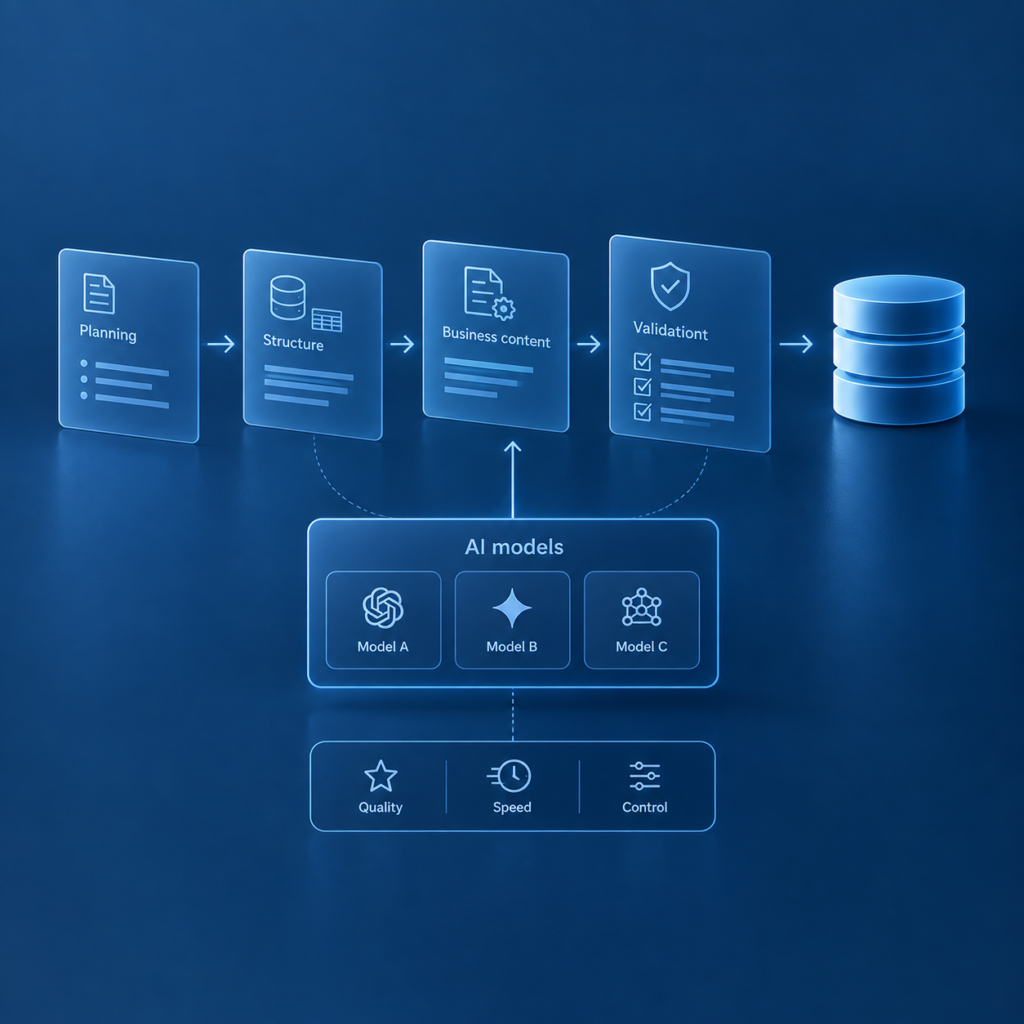
We built a generation engine that combines database structure with a plain-language description of the scenario needed. The system figures out what to generate, in what order, and with what context, surrounding the AI model with the guardrails needed to turn open-ended output into clean, structured data.
- Uses everything available. The database structure, rules, and scenario description all shape what gets generated.
- Plans the full structure first. Tables are built in the right order, from core records through to the details that connect them.
- Builds structure before content. Keys and relationships are set up before business data is added, so accuracy is locked in early.
- Keeps the story consistent. Related records, like a contract, its invoices, and its payments, stay aligned with each other.
- Checks and corrects the output. Errors, duplicates, and rule violations are caught and fixed automatically before final validation.
The completed system included live database integration, automated validation, multiple working business scenarios, and support for several different AI models, proving the concept end-to-end and laying the groundwork for full product integration.

We designed and delivered an end-to-end synthetic data system that combines deep learning with purpose-built database logic. Rather than generating each table in isolation, the system first studies the full database, its structure, relationships, and rules, then builds new records in the correct order, starting with root records and adding the connected details that complete each entity.
- Learn how the data behaves. Deep learning models capture patterns within each table and the relationships between them.
- Builds connected records. New data is generated in the right order, with fresh identifiers and the links between tables intact.
- Handles specialized data correctly. Purpose-built models generate realistic names, emails, and IDs, while simpler rules handle dates and formatted values where a full model isn’t needed.
- Preserves business logic. Automated checks confirm that relationships and rules not directly visible in the database structure still hold true.
- Measure the result. An evaluation layer compares real and synthetic data on structure, relationships, validity, and how genuinely new the synthetic data is.
The system was delivered as a set of services inside the client’s existing cloud environment, so training, generation, and evaluation all run as repeatable tasks the client’s team can reuse and build on.

The client gained a validated way to generate realistic data even when no real data exists yet. Business users can describe what they need in plain language, and the system turns that into a complete, connected dataset, opening up earlier product design, database planning, and demos without waiting for real data to become available.
Structural accuracy reached 91-95% on complex, real-world-style databases, and 99.5%+ on simpler ones. Testing across different AI models showed a clear trade-off: a higher-quality model completed generation in 6.8 hours at 91.5% accuracy, a self-hosted model took 17.8 hours at 89.7%, and a faster model finished in under an hour at 82.6%, giving the client real evidence to choose the right balance of speed, cost, and quality for each use case.
The result: proof that a complete, trustworthy database can be built from nothing but a description, turning a missing dataset from a blocker into a new product opportunity.